

You are using an out of date browser. It may not display this or other websites correctly.
You should upgrade or use an alternative browser.
You should upgrade or use an alternative browser.
AI generation is getting pretty good
- Thread starter Kev The Galaxybender
- Start date

Kev The Galaxybender
New member


O Ilusionista
Captain 100K
Depends too much on which tool you use. This one has the typica AI issues
Kev The Galaxybender
New member
yupDepends too much on which tool you use. This one has the typica AI issues
View attachment 10911


Blaze Rhodon
Member
I also tried to use ChatGPT and sadly its creations are too rough and they lack of virtual beauty. I'm going to learn how to use stable-diffusion LoRa (low-rank adaptation) models because they are much more detailed and prettier than standard ChatGPT creations. By the way my current avatar is creation of stable-diffusion LoRa model.
ford1reil138
New member
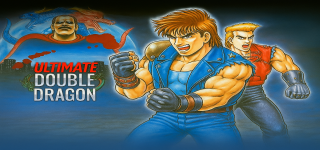
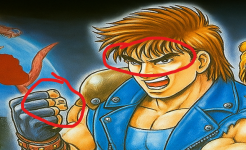
When the AI starts to finish or clean up what it's told the first time, then it'll be wow. But for now, sometimes the AI doesn't do what I expect.I needed a hero banner for Steam for UDD. I couldn't get it quite right myself so I asked Chatgpt to finish the image for me and have him make a fist. It did a pretty good job.
I sometimes finish drawing small details myself or correct the anatomy of the fingers through artificial intelligence when I make covers, because drawing fists from scratch is always a pain in the ass. It's nice to watch people share their experiences using new technologies and digital tools for development. If you're looking for useful tips or discussions about software for working with graphics and productivity, you can find on the forum a lot of interesting solutions from other developers . And how many generations did it take to get exactly the right shape of the hand and fist?


Last edited:


O Ilusionista
Captain 100K
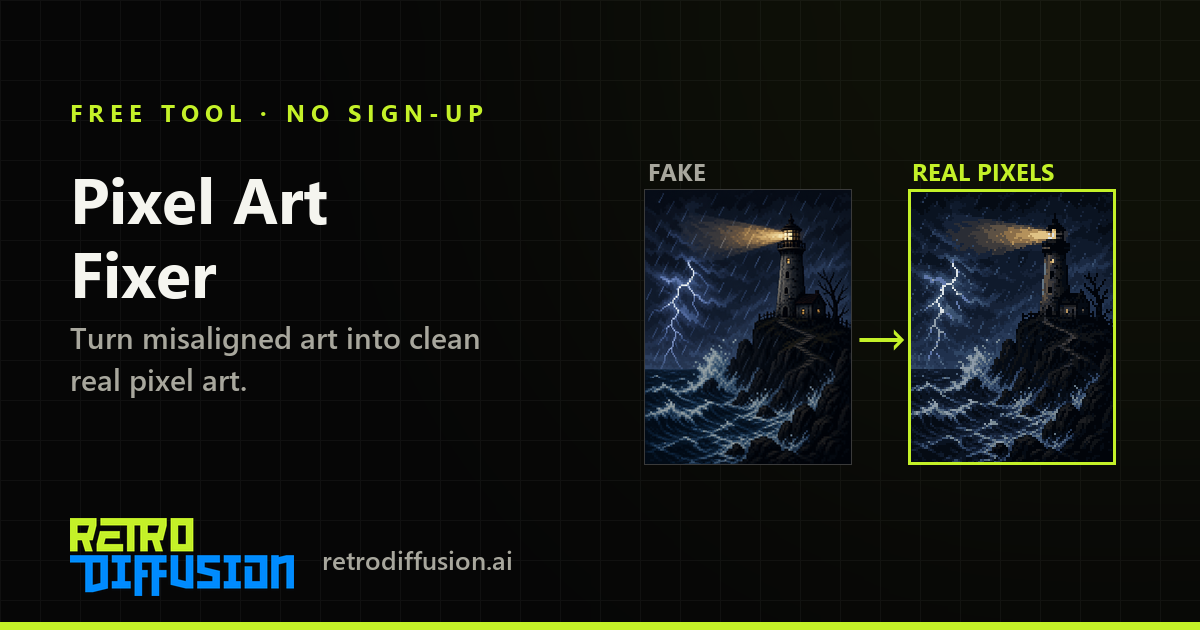
I won't say on point - neither its pixel art. If zoom, you will see that they are voxels.I must say Retro diffusion gets Pixelart on point:

Seraphy
New member
??? can you explain ?I won't say on point - neither its pixel art. If zoom, you will see that they are voxels.
Seraphy
New member
Maybe it needs a fix
 retrodiffusion.ai
the fixer makes everthing align with a pixelart grid, for free
here the fixed portrait image
Free AI Pixel Art Fixer: Convert Images Into Real Pixel Art | Retro Diffusion
Fix fake AI pixel art for free. Upload an image and the Pixel Art Fixer detects the implied grid, snaps every cell to a true pixel, and gives you real, game-ready pixel art. No signup.
retrodiffusion.ai
the fixer makes everthing align with a pixelart grid, for free
here the fixed portrait image
Last edited:

NED
Well-known member
is it completly free or after a certain time you cannot use the website anymore ever?Maybe it needs a fix
Free AI Pixel Art Fixer: Convert Images Into Real Pixel Art | Retro Diffusion
Fix fake AI pixel art for free. Upload an image and the Pixel Art Fixer detects the implied grid, snaps every cell to a true pixel, and gives you real, game-ready pixel art. No signup.
the fixer makes everthing align with a pixelart grid, for free
here the fixed portrait image View attachment 15687
(Yes, I know...)
O Ilusionista
Captain 100K
yep, its one of the issues with those "pixel arts".the fixer makes everthing align with a pixelart grid, for free
edit: the site even explain this

Last edited:

yep, its one of the issues with those "pixel arts".
edit: the site even explain this
View attachment 15689
Same thing I tried to explain to Wombat, and of course he wouldn't listen. Model agents can do some amazing things - but the tech for prompting sprite assets just isn't there yet. When you actually understand how the AI works, you understand why. Consistent pixel art is directly opposed to how models construct output.
And here's what the AI itself has to say on the matter:
Exactly. The conflict is structural, not merely a matter of immature prompting.
Image models do not ordinarily construct pixel art as a grid of deliberately placed cells. They generate a continuous visual field, then decode it into raster pixels. “Pixel art” in the prompt mainly becomes a style signal - blocky edges, limited-looking colors, simplified shading. The model still freely introduces:
Sprite animation makes the problem much worse. Production sprites require invariants across every frame: palette, scale, proportions, outline weight, feature placement, lighting, registration, and attachment points. Changing the pose should move the character’s parts. Generative models tend to redraw the entire character, allowing all those supposedly fixed properties to drift simultaneously.
- Off-grid boundaries
- Fractional or irregular pixel blocks
- Near-duplicate colors
- Blended edges and compression-like noise
- Inconsistent outlines
- Soft or contaminated transparency
That is the key distinction the graphic captures: the model produces an image that resembles pixel art, not a pixel-art asset.
Model agents can still be enormously useful around the process. They can generate concepts, operate deterministic conversion tools, infer a likely grid, consolidate colors, clean alpha, pack atlases, and help a human correct frames. Once a fixer snaps cells, enforces a palette, and reconstructs the image, though, the reliability comes from those deterministic constraints - not from prompting the image model more cleverly.
Technology capable of producing dependable sprite assets probably needs a different representation: explicit cells, indexed palettes, persistent character structure, animation constraints, and reusable parts. Until then, telling the model “consistent 16-bit sprite sheet, exact palette, transparent background” is mostly asking a continuous painter to convincingly imitate discrete engineering.
DC
Seraphy
New member
it only accepts pictures that are 1024x1024 or 512x512is it completly free or after a certain time you cannot use the website anymore ever?
(Yes, I know...)